
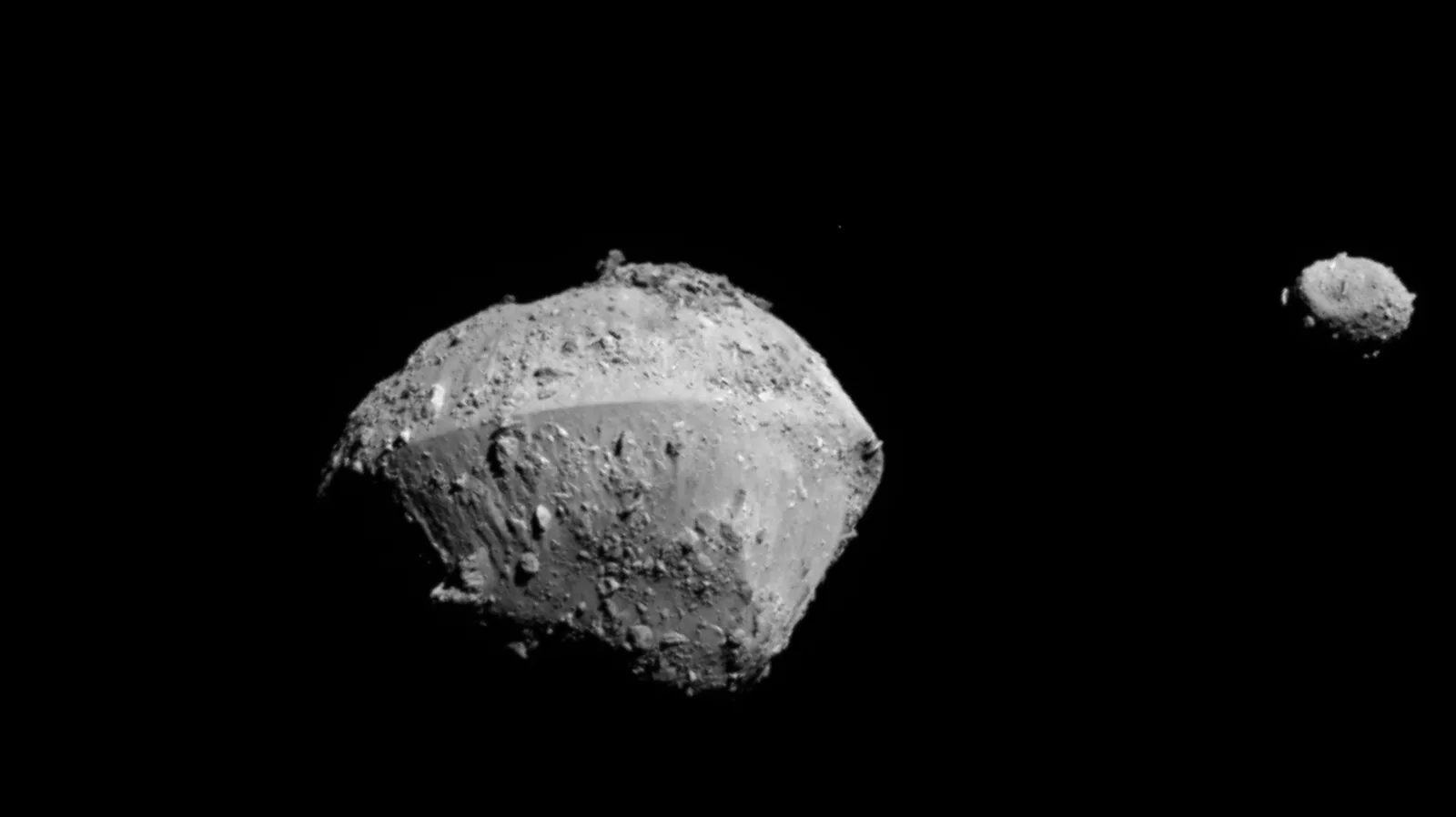
Humanity has taken a significant leap forward in its ability to protect Earth from cosmic threats following new discoveries by the European Space Agency’s Hera spacecraft. Traveling over 120 million miles, Hera recently arrived at the Didymos asteroid system to survey the damage caused by NASA’s DART mission back in 2022. While scientists already knew that slamming a probe into the moonlet Dimorphos had successfully shifted its orbit, they were unsure exactly how the physical structure of the rock had reacted to such a violent encounter.
The newly released imagery reveals a scene of chaotic destruction. Hera found that the impact didn’t just nudge the asteroid but essentially flattened one side of it, leaving behind a massive crater roughly the size of a sports stadium that spans the entire width of the moonlet. Beyond the crater, the strike sent Dimorphos spinning wildly in its orbit and blasted hundreds of smaller boulders into space, creating a swirling cloud of debris surrounding the binary asteroid system.
Despite these dramatic changes, researchers noted that areas away from the impact site remain largely untouched, looking much as they did during initial observations years ago. To gather even more precise data, Hera is currently maintaining a tight orbit around the asteroids and plans to move even closer soon. The mission will culminate in the deployment of two miniature satellites, Juventas and Milani, which will probe the internal composition and gravitational pull of Dimorphos for the first time in history.
These findings were presented at a poignant setting in Berlin’s museum among dinosaur fossils, serving as a grim reminder of why this research matters. By understanding exactly how an asteroid reacts to being hit, scientists can refine their strategies for diverting potential world-ending threats. As project leaders pointed out, while an asteroid once wiped out the dinosaurs sixty six million years ago, humans are now developing the actual tools needed to ensure history does not repeat itself.