
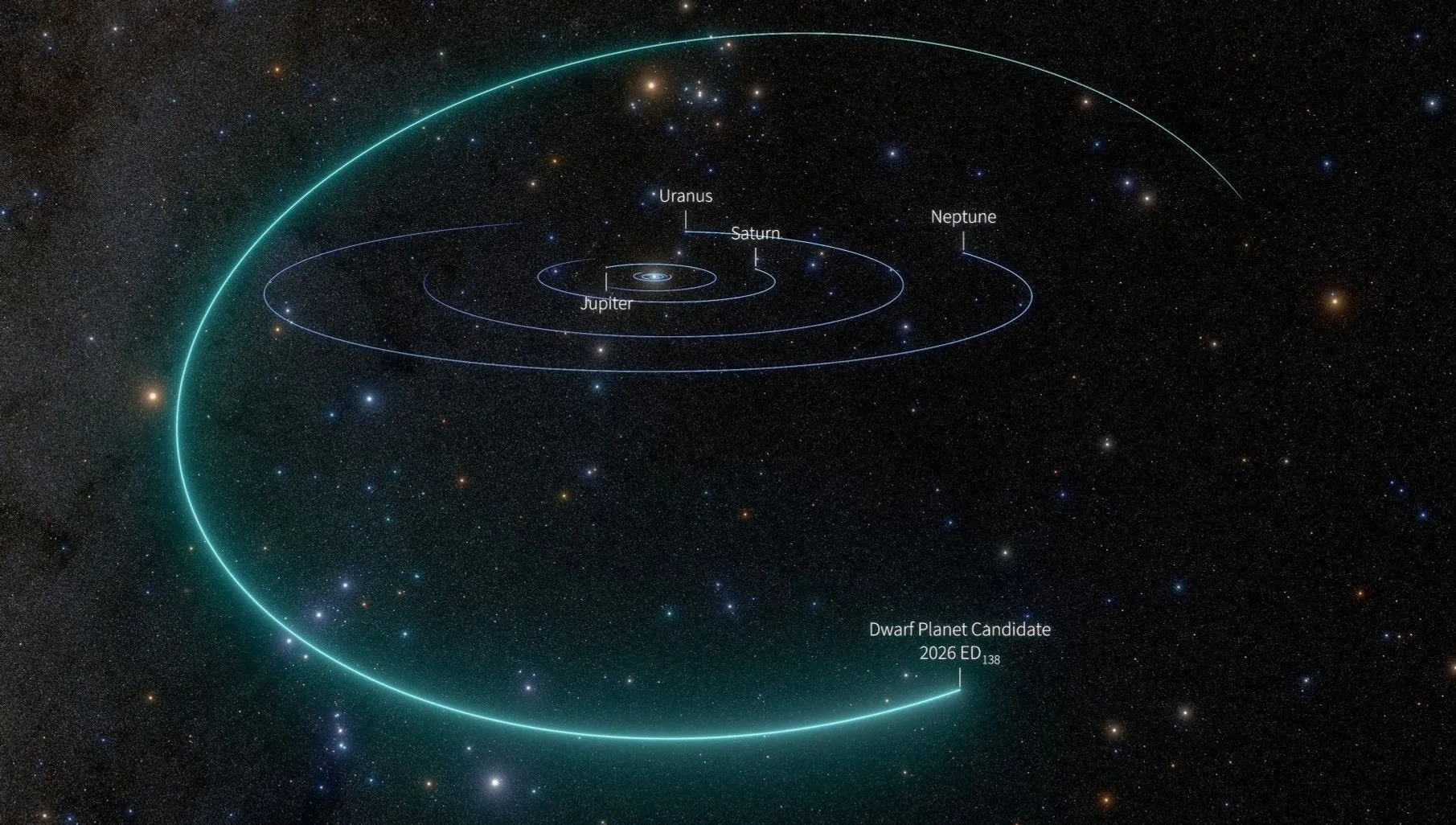
Astronomers may have just expanded our map of the solar system thanks to a stunning find in the frozen reaches beyond Neptune. Using the cutting edge capabilities of the Vera Rubin Observatory in Chile, researchers have spotted a massive icy object designated 2026 ED138. Initial estimates suggest the body is between 600 and 1,500 kilometers wide, which means it possesses enough gravity to pull itself into a spherical shape. If this proves true, the object would officially be classified as a dwarf planet, joining an exclusive club that currently includes only Pluto, Ceres, Eris, Haumea, and Makemake.
The discovery happened almost by accident on October 13 when Matthew Holman of the Center for Astrophysics | Harvard & Smithsonian ran existing observatory data through a custom search code he co-developed with Kevin Napier. Holman recalls feeling a sense of excited disbelief when the results popped up because objects of this scale and brightness are incredibly rare in such distant orbits. To ensure it wasn’t a software glitch, he meticulously cross referenced the findings against the observatory’s vast catalog and eventually found corroborating evidence from as far back as 2016 via the Dark Energy Camera.
Located roughly 46 astronomical units from the sun, this newcomer resides even further out than Pluto’s average position. Interestingly, its orbit is tilted about 25 degrees away from the rest of the solar system’s plane, leading scientists to believe that a past gravitational encounter with Neptune likely knocked it off course long ago. Because it is so remote and cold, confirming its status as a dwarf planet requires precise measurements of its size that can only be achieved through infrared observations, potentially involving NASA’s James Webb Space Telescope.
This finding highlights the incredible power of the Vera Rubin Observatory and its ongoing Legacy Survey of Space and Time. By capturing high resolution images of the southern sky every few days with the world’s largest digital camera for astronomy, scientists are essentially creating a time lapse movie of our cosmic neighborhood. While they hope to unlock secrets regarding dark matter and energy, they are also conducting a comprehensive census of our local space. With over 11,000 asteroids already identified by the facility, experts expect that many more hidden worlds like 2026 ED138 will emerge from the darkness in the coming decade.