
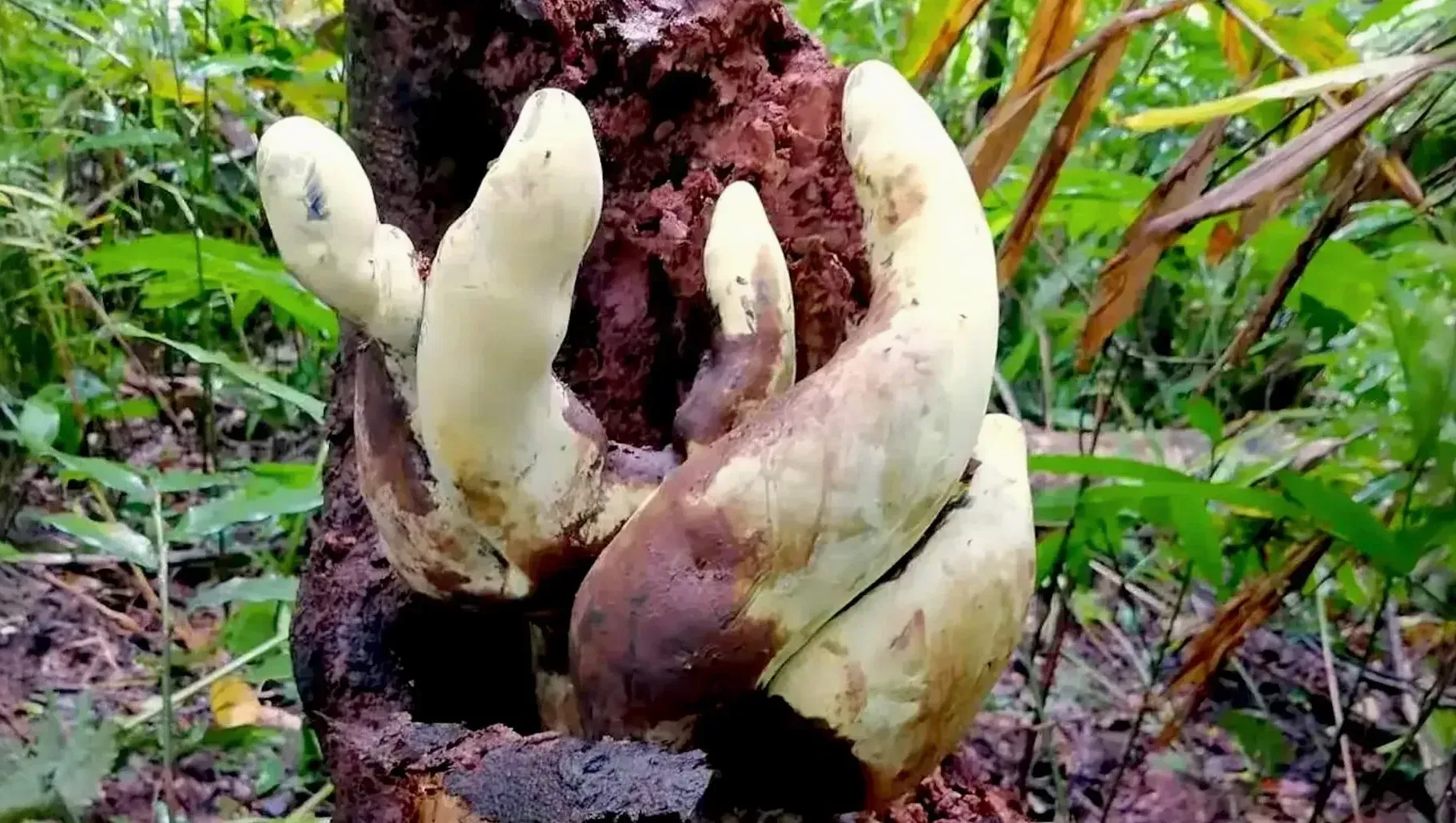
Deep within the diverse landscapes of Yunnan, China, scientists have stumbled upon a biological marvel that is rewriting the rulebook on fungal growth. While surveying various forest environments, researchers from the Kunming Institute of Botany discovered an imposing organism now known as Dianjunus rex. Nicknamed D-rex due to its massive scale, this fungus produces towering white reproductive structures that can reach heights of 20 inches and weigh nearly five pounds, far surpassing any previously recorded members of its phylum.
The discovery is so significant that experts had to establish an entirely new fungal family, Dianjunaceae, to accommodate it. Genetic sequencing and physical analysis revealed that D-rex differs fundamentally from other known fungi in its order. Growing from the roots of Chinese cork oak trees, these giants utilize specialized enzymes to break down complex organic matter in the soil, allowing them to thrive in the nutrient-rich environment of the rhizosphere.
Perhaps most fascinating is the timeline associated with this prehistoric titan. Using molecular clock dating, researchers estimated that the lineage began roughly 65 million years ago, appearing shortly after the mass extinction event that wiped out the non-avian dinosaurs. Scientists speculate that the resulting chaos and abundance of dead plant material provided a perfect ecological opening for such a unique decomposer to evolve and dominate its niche.
Beyond its age, biologists are intrigued by why D-rex grew so large compared to its cousins. Dr. Indunil C Senanayake suggests that by towering over the forest debris and low-lying vegetation, the fungus can better catch wind currents to disperse its spores across wider distances. While building such a heavy structure requires immense energy, the trade-off appears worth it in the competitive canopy of East Asia’s forests, hinting at a vast world of undiscovered biodiversity still hiding beneath the loam.