
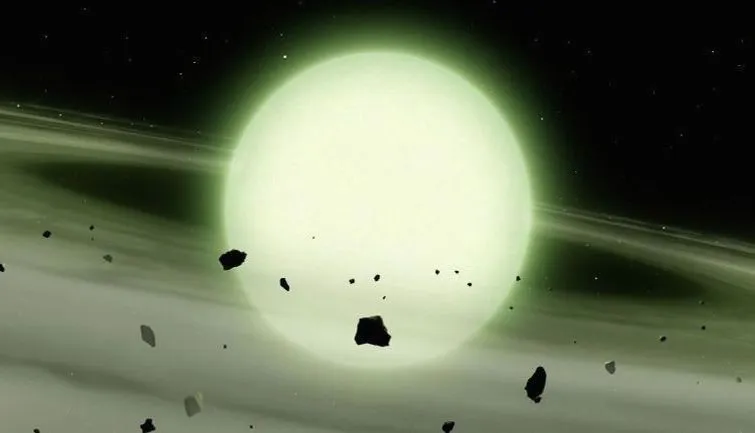
For as long as humans have looked at the night sky, the palette of the stars has seemed predictable, consisting mostly of whites, oranges, and deep blues. However, a recent study led by Mark Hollands, an astrophysicist at the University of Warwick, has revealed a startling exception to this rule. By analyzing the spectral fingerprints of white dwarf stars, astronomers have identified the first star that would appear green to the human eye. While typical stellar colors are dictated strictly by temperature, these dense remnants of dead suns possess unique atmospheric conditions that allow for a far more vivid array of hues.
This unusual coloration is not merely a visual curiosity but serves as a chemical map of a star’s violent history. White dwarfs can act as cosmic vacuum cleaners, shredding asteroids or entire planetary systems that venture too close. When this rocky debris falls into the star’s outer layers, elements like calcium, sodium and lithium mix with helium to alter the light emitted. In the case of the newly discovered green star, this specific cocktail of minerals created a hue rarely seen in nature. Other stars in the survey displayed equally strange colors, including one described as resembling salmon pink due to high concentrations of carbon molecules.
Professor Adam Burgasser from the University of California San Diego describes these stars as galactic crime scenes. By studying the proportions of different elements reflected in these odd colors, scientists can effectively perform an autopsy on destroyed planets to understand how they were originally formed billions of years ago. Although these stars are too distant to be viewed in such detail with the naked eye from Earth, calculating their appearance provides a visceral human connection to objects that otherwise feel abstract and unreachable.
Looking ahead, researchers expect a surge in similar discoveries as new spectroscopic surveys begin delivering massive amounts of data. With a projected tenfold increase in available spectra for white dwarfs, Hollands hopes to find many more emerald gems hidden in the darkness. This shift toward categorizing stars by how they would actually look to us blends physics with biology and offers a simpler way for astronomers to organize complex atmospheric data while capturing the imagination of the public.