
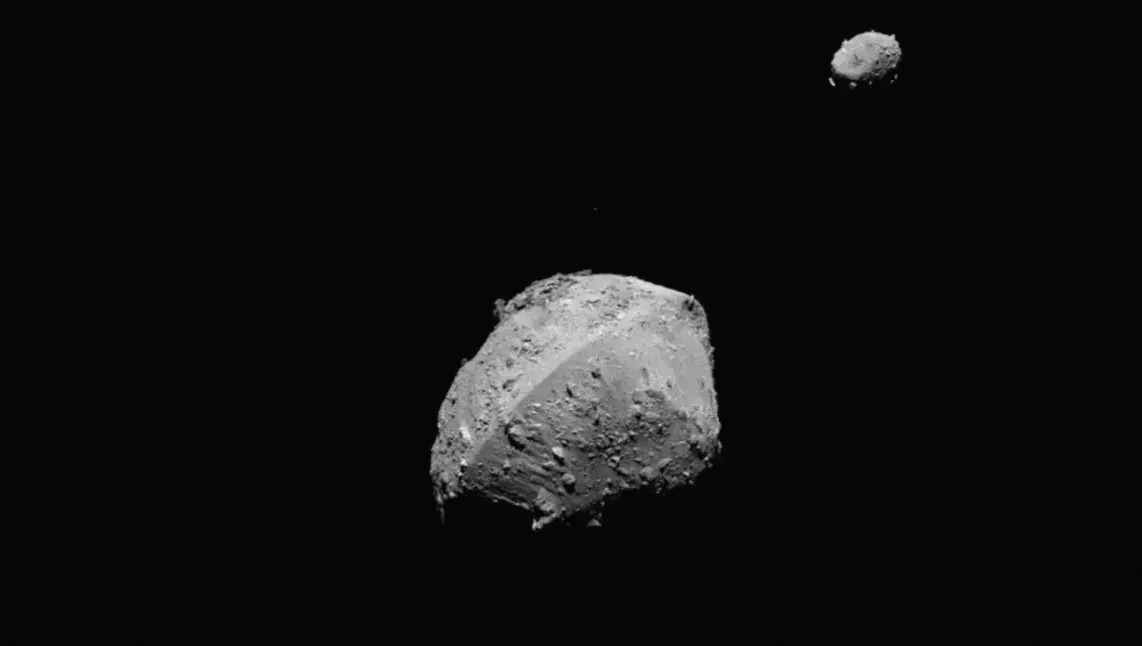
Space agencies are finally seeing the wreckage of history’s first intentional planetary defense test. Two years after NASA slammed a spacecraft into the asteroid Dimorphos at speeds approaching 15,000 miles per hour, the European Space Agency’s Hera mission has arrived to document the damage. The latest high-resolution images reveal a scene of absolute chaos, featuring a massive impact crater roughly the size of a sports stadium that has effectively flattened one entire side of the small space rock.
The collision did more than just scar the surface; it fundamentally altered how Dimorphos behaves in space. While ground-based telescopes previously confirmed that the hit shortened the asteroid’s orbit around its larger companion, Didymos, Hera’s close-up views show the moonlet is now tumbling wildly through the void. Even more surprising to researchers is the discovery of hundreds of boulders circling the binary system, debris likely blasted loose during the violent encounter between the DART probe and the asteroid.
Patrick Michel, the principal investigator for Hera, noted that scientists had spent months debating whether the impact actually created a crater or simply shifted the rock’s shape. As it turns out, every theory was correct. This revelation transforms a successful physics experiment into a comprehensive study of celestial mechanics, providing critical data on how rubble-pile asteroids react when struck by high-velocity objects.
Hera is only beginning its deep dive into this cosmic crime scene. Over the next several months, the car-sized craft will drift even closer to capture finer details before deploying two miniature satellites in 2027 to analyze material composition and peer beneath the surface with radar. By pairing NASA’s initial strike with ESA’s forensic analysis, scientists hope to turn asteroid deflection from a daring gamble into a reliable shield for Earth against future threats.