
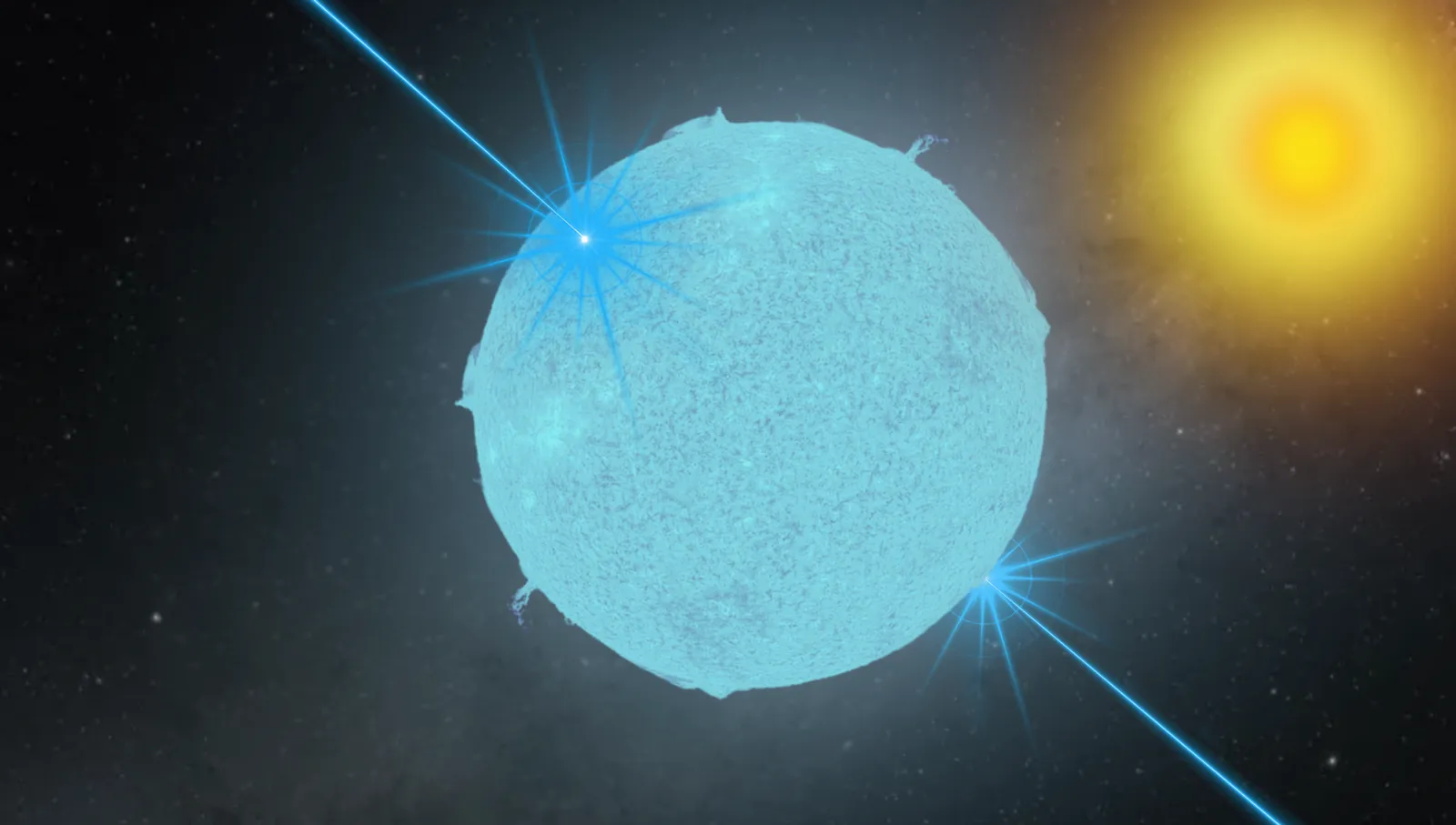
Astronomers have finally unmasked the source of a puzzling set of radio signals emanating from deep space, tracing them back to an unlikely pairing about 5,000 light-years away. This celestial odd couple consists of a dense, dead white dwarf and a larger companion star very similar to our own sun. While these types of erratic bursts are sometimes seen in systems featuring cool red dwarfs, it is exceptionally rare to find them occurring alongside a sun-like star, making the discovery of the system known as GPM J071507-114153 a significant milestone for researchers.
The white dwarf acts as a galactic lighthouse, spinning rapidly every eight minutes and emitting rhythmic pulses. For years, scientists have studied long period transients, which are objects that flicker on and off over several minutes or hours, but they often struggled to pinpoint which star in a pair was actually responsible for the noise. In this case, the signals were so crisp that team leader Sam McSweeney and his colleagues could actually track the white dwarf moving through its orbit. This provides definitive evidence that the pulsations originate from the white dwarf itself or its immediate surroundings.
Beyond solving the mystery of the pulses, the observation offered an unexpected glimpse into the violent weather of the companion star. By monitoring the radio waves, astronomers detected massive solar flares and witnessed the white dwarf passing behind a stellar prominence—a giant loop of plasma erupting from the sun-like star’s surface. Being able to witness such atmospheric storms across thousands of light-years highlights just how powerful modern radio astronomy has become.
The discovery was made possible through a global effort involving scanners in Australia and South Africa, followed by visual confirmation from the Keck Observatory in Hawaii. As these instruments serve as predecessors to the upcoming Square Kilometre Array, which will be the world’s largest radio telescope project, scientists believe this is only the beginning. They expect that once the full array is operational, they will uncover countless more strange stellar pairings and gain an even deeper understanding of how these exotic systems behave.