
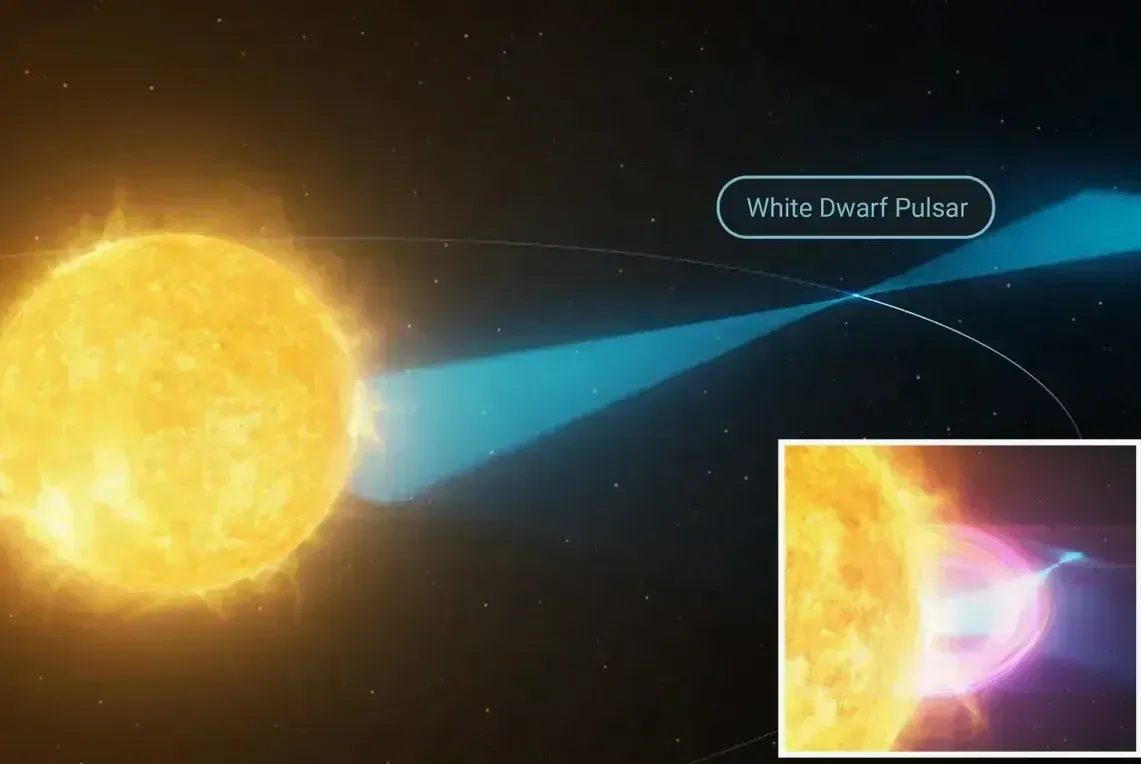
Astronomers in Australia have stumbled upon a cosmic anomaly thousands of light years away that behaves like a giant galactic clock. Every eight minutes, a mysterious set of radio signals beams across the void toward Earth, originating from a strange binary system known as GPM J071507-114153. Located roughly 5,000 light years away, this pairing consists of a dense white dwarf—the leftover core of a deceased star—and a stable G-type star very similar to our own sun.
The discovery, published in the journal Nature Astronomy, marks the first time scientists have detected these specific radio pulses from a white dwarf orbiting a sun-like companion. While researchers at the International Centre for Radio Astronomy Research had seen similar patterns before, they typically occurred with much smaller and cooler red dwarfs. This particular system belongs to a rare category called long period transients, which act like interstellar switches that flip on and off over periods ranging from mere minutes to several hours.
Lead author Dr. Sam McSweeney explains that the clarity of these signals finally allowed his team to track the movement of the white dwarf within its orbit. By processing over 100 hours of data via the Pawsey Supercomputing Research Centre, the team confirmed that the pulsations are emanating directly from the vicinity of the dead star. The precision of these signals acted almost like a flashlight, illuminating other hidden features of the system including massive loops of plasma erupting from the neighboring sun-like star.
Associate Professor Natasha Hurley Walker noted that being able to witness stellar flares and magnetic storms on a star so distant is truly remarkable. To pin down the location of this celestial duo, the team utilized an impressive array of technology, starting with scans from Western Australia and refining coordinates with South Africa’s MeerKAT telescope before final confirmation came from Hawaii’s Keck Observatory. As next generation telescopes come online, astronomers expect to uncover many more of these rhythmic anomalies hiding in the depths of the Milky Way.