
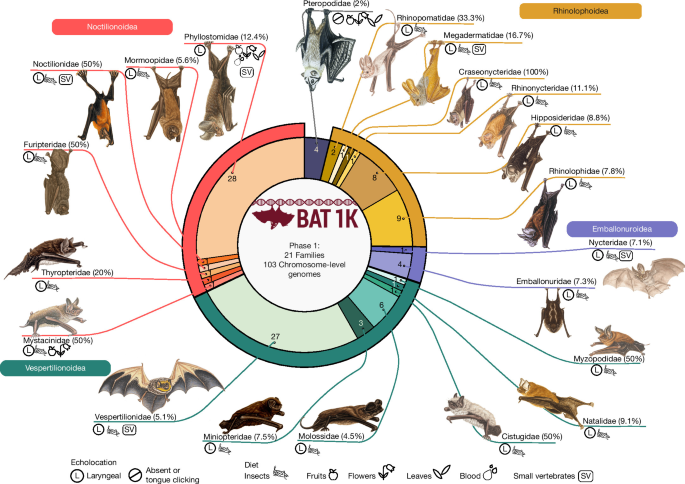
Scientists are finally beginning to untangle the complex ancestral web of bats, animals that make up more than a fifth of all living mammal species. For decades, researchers have struggled to map the evolutionary journey of these creatures because their genetic markers can be misleadingly similar across different groups and the fossil record remains frustratingly fragmented. While ancient skeletons from 56 million years ago prove that flight and echolocation existed early on, those discoveries only provide a tiny snapshot of a much larger story, leaving experts divided on whether bats first emerged in Asia, Africa, or North America.
To break this deadlock, an international effort known as the Bat1K consortium has launched an ambitious mission to sequence reference quality genomes for every single living bat species. In the first phase of this project, researchers successfully produced chromosome level assemblies for all twenty one recognized bat families. By using advanced long read sequencing and Hi C technology, the team created highly detailed genomic maps that far surpass previous low quality fragments. This massive dataset now includes over one hundred species, covering everything from fruit eaters to blood suckers and including elusive families endemic to places like Madagascar and New Zealand.
This genomic breakthrough allows scientists to look past the confusing physical similarities that often mask true evolutionary relationships. By combining these precise genetic blueprints with existing fossil data, the research provides a clearer picture of how bats diversified into so many specialized ecological niches. Beyond just mapping family trees, this work helps explain why bats possess such extraordinary biological traits, such as their unusual resistance to cancer and their ability to carry various viruses without becoming ill themselves.
By filling in these critical gaps in the evolutionary timeline, the study moves closer to resolving where these winged mammals originated and how they spread across the globe. The precision offered by these new reference genomes means that future studies will no longer have to rely on guesswork or incomplete data when discussing the arrival of powered flight. Instead, biologists now have a comprehensive toolkit to explore how one of nature’s most successful mammalian orders managed its rapid rise to global dominance.