
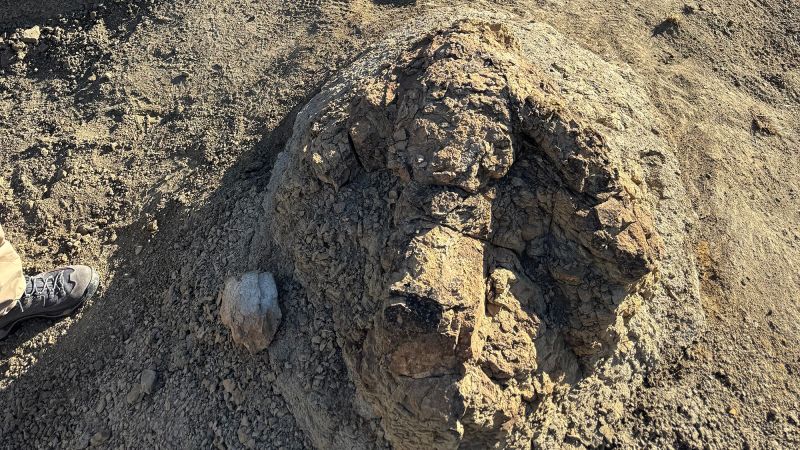
Kent Hups, a high school science teacher from Northglenn, Colorado, spent his morning wandering through the Hell Creek Formation, a region famous among paleontologists for its wealth of Late Cretaceous fossils. While the area is usually a goldmine for dinosaur bones, actual footprints are incredibly rare because the local sediment typically erodes before tracks can be preserved. Despite the odds, Hups happened to glance down and see something that stopped him in his tracks: two massive, three-pronged impressions etched into the stone. His initial reaction was total disbelief, leaving him staring at the ground for several minutes before he dared to believe he had found a genuine prehistoric print.
The scale of the find immediately suggested something monumental. By measuring the traces, Hups noticed that the length significantly exceeded the width—a classic sign of a carnivorous dinosaur. Each print stretched roughly three feet long and over two feet wide, dimensions that pointed toward only one possible culprit: the Tyrannosaurus rex. This discovery represents a major milestone for science because while isolated footprints have been found previously, this site provided something far more valuable: a trackway. Along with Tyler Lyson from the Denver Museum of Nature and Science, researchers eventually uncovered five distinct prints, confirming a sequence of movement rather than just random markings in the rock.
For scientists, these tracks act as a window into behaviors that skeletal remains simply cannot reveal. According to details published in the Journal of Vertebrate Paleontology, this particular trail offers the first direct evidence of a T. rex’s stride length. Based on the distance between the four primary prints—roughly 13 feet—researchers estimate that this specific apex predator was strolling at about 3.5 to 4.5 miles per hour through what was once a lush coastal floodplain millions of years ago. Though this pace is far slower than its top sprinting speed, it gives experts an unprecedented glimpse into how these giants moved during their daily lives.
The rarity of such finds makes this discovery particularly poignant for both professionals and amateurs alike. Because trackways are so scarce in North American deposits from this era, even partially eroded examples are considered precious records of ancient life. For Kent Hups, who continues to work as a volunteer researcher alongside his teaching career, the experience serves as an inspiration for others to keep exploring their surroundings. He describes such discoveries as the closest thing humans have to a time machine, capturing just a few fleeting seconds of existence from sixty six million years ago.