
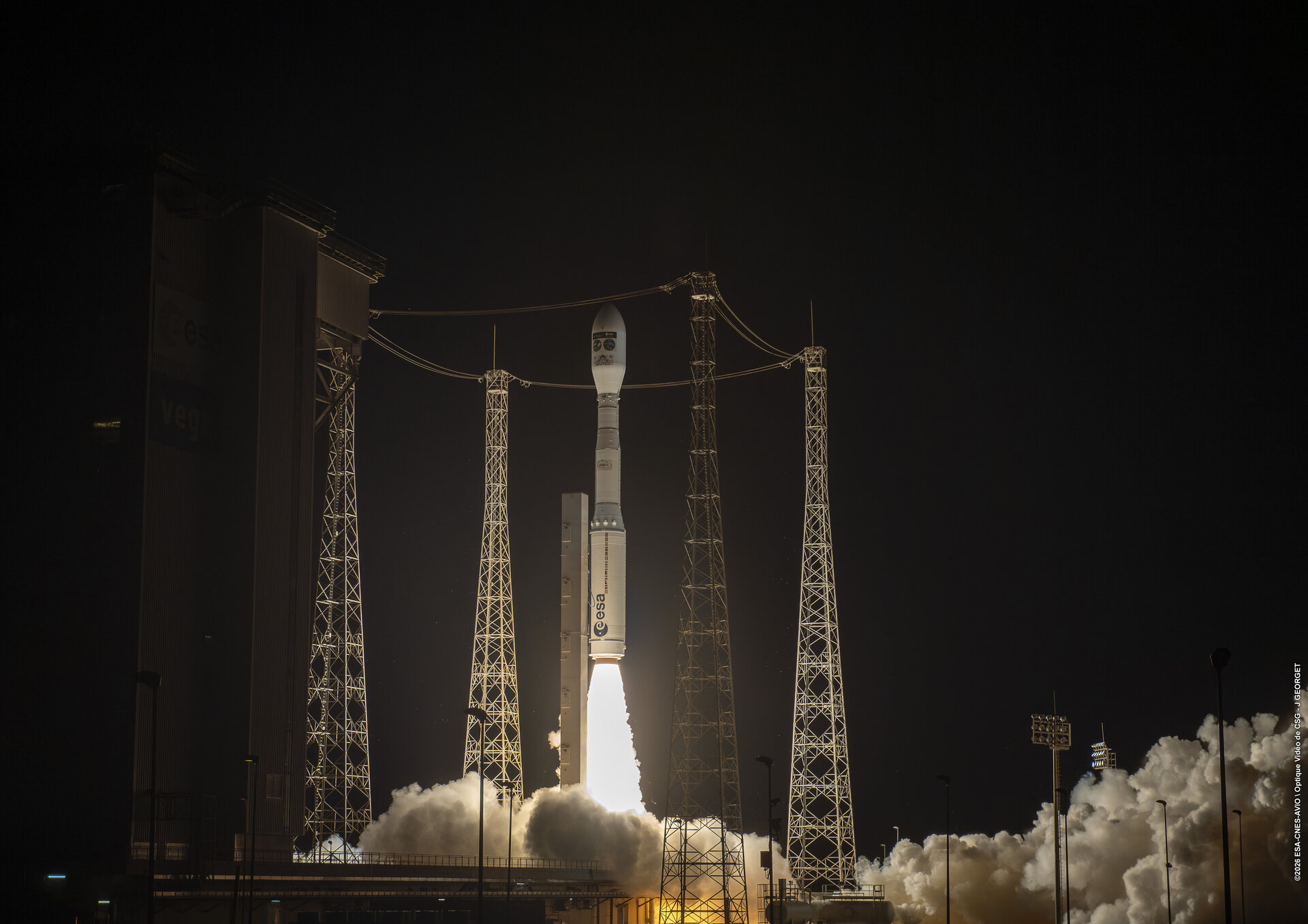
Europe has taken another significant step forward in its quest to monitor the planet’s health with the simultaneous launch of the FLEX and Sentinel-3C satellites. Lifting off from Europe’s Spaceport in French Guiana aboard a Vega-C rocket on September 15, the two spacecraft were deployed using a specialized adapter called Vespa. While Sentinel-3C was injected into orbit first, FLEX followed about an hour later, with both subsequently establishing critical communication links with the European Space Operations Centre in Germany.
The dual mission represents a marriage of high-level research and systematic environmental surveillance. FLEX is a pioneering research mission designed to act as a cosmic stethoscope for Earth’s greenery. By utilizing a Fluorescence Imaging Spectrometer, it will detect faint signals invisible to the human eye that indicate how efficiently plants convert sunlight and carbon dioxide into energy. This data will allow scientists to better understand plant stress and the overarching impact of climate change on global ecosystems.
Complementing this focused study is Sentinel-3C, the newest addition to the Copernicus program’s fleet of environmental monitors. This satellite serves as a wide-angle lens for the planet, tracking everything from ocean temperatures and sea ice conditions to inland water levels and atmospheric changes. Once it passes its initial commissioning phase, operation of Sentinel-3C will transition to Eumetsat, ensuring that real-time data continues to flow to researchers and policymakers worldwide who rely on these metrics for weather forecasting and resource management.
Simonetta Cheli, ESA’s Director of Earth Observation Programmes, described the successful launch as the result of years of international cooperation and engineering precision. The complexity of the mission extends beyond just getting into space; once settled in orbit, FLEX will perform orbital gymnastics to fly in tandem with members of the Sentinel family. This strategic positioning allows scientists to combine FLEX’S specific vegetation data with broader atmospheric observations from Sentinel satellites, creating an unprecedentedly detailed picture of Earth’s biological vitality.