
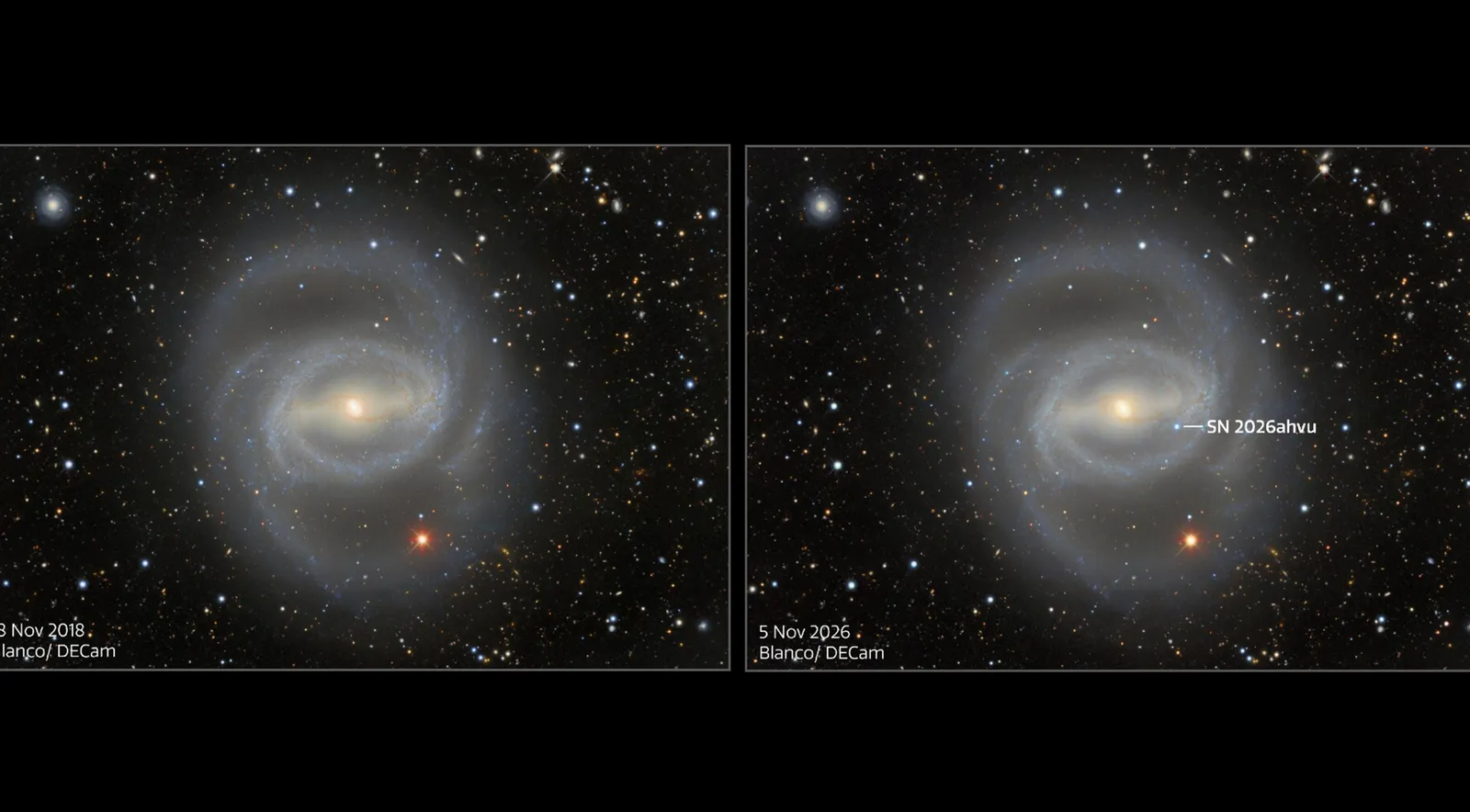
Astronomers have captured a rare glimpse into the violent death of a star within the spiral galaxy NGC 1433, located roughly 50 million light years away. The event, designated as supernova SN 2026ahvu, is a Type Ia supernova, which occurs in binary systems where a white dwarf feeds off its companion star. Once the white dwarf accumulates enough matter to reach a critical limit, it triggers a colossal thermonuclear explosion that illuminates the surrounding void.
While spotting supernovas is common in modern astronomy, this particular discovery is remarkable because of its timing. Most distant explosions are detected long after their peak brightness has passed, leaving scientists to piece together the story from fading embers. In this case, however, observers caught SN 2026ahvu while it was still brightening, meaning they witnessed the eruption almost as it happened. This provides a precious window for researchers to study the immediate dynamics of the blast and how it reshapes its local galactic neighborhood.
In a twist of cosmic luck, the explosion was first flagged by ATLAS, a network of robotic telescopes primarily designed to act as an early warning system for asteroids heading toward Earth. Although built to protect our planet from rogue space rocks, the system proved equally capable of detecting deep space phenomena. Following the initial alert from ATLAS, teams used more powerful instruments like Gemini South and NOIRLab’s Dark Energy Camera to document the unfolding catastrophe in vivid detail.