
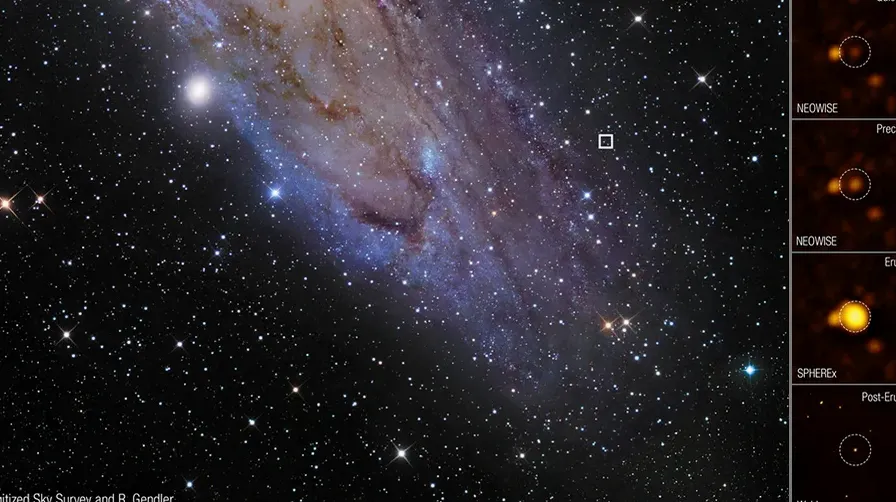
For decades, astronomers have theorized about a violent celestial phenomenon called common envelope evolution, where one star essentially eats another to create tight binary pairs. While the theory dates back to the 1970s, scientists had never actually seen it happen in real time until now. A team led by astrophysicist Viraj Karambelkar from Columbia University recently documented the entire process in the Andromeda Galaxy, witnessing a giant star seven times the mass of our sun slowly consume its smaller neighbor before ending in a spectacular eruption.
The drama unfolded over several years, appearing as a mere blink in cosmic terms. Using data from various telescopes including NASA’s NEOWISE and the WINTER telescope at Palomar Observatory, researchers tracked a system dubbed AT 2025abao. For years, the giant star remained quiet, but starting around 2018, it began to brighten significantly. This increase in luminosity was caused by the smaller companion star spiraling inward through the giant’s outer layers. Much like a spacecraft reentering Earth’s atmosphere, the friction generated by the companion dragging through gas heated up the stellar envelope and released immense amounts of energy.
By mid 2025, the situation reached a breaking point. After expanding to roughly 860 times the width of our sun and wrapping itself in thick clouds of dust, the system experienced a sudden and violent climax in October. The orbiting companion plunged rapidly toward the center of its larger partner, crashing directly into its core. This collision acted like a bomb detonating inside the star, triggering a luminous red nova that saw the object brighten 100 fold in less than a month, peaking at a brilliance equivalent to 1.5 million suns.
While some stellar mergers result in two stars remaining locked in a tight dance, calculations suggest this particular encounter ended in total consumption. By analyzing how energy was distributed during the blast, Karambelkar’s team found that most of the power went into hurling huge chunks of stellar material into space rather than radiating as light. This indicates that the smaller star did not survive as a separate entity but instead merged completely with its host’s core, providing rare and definitive proof of how these galactic collisions shape the universe.