
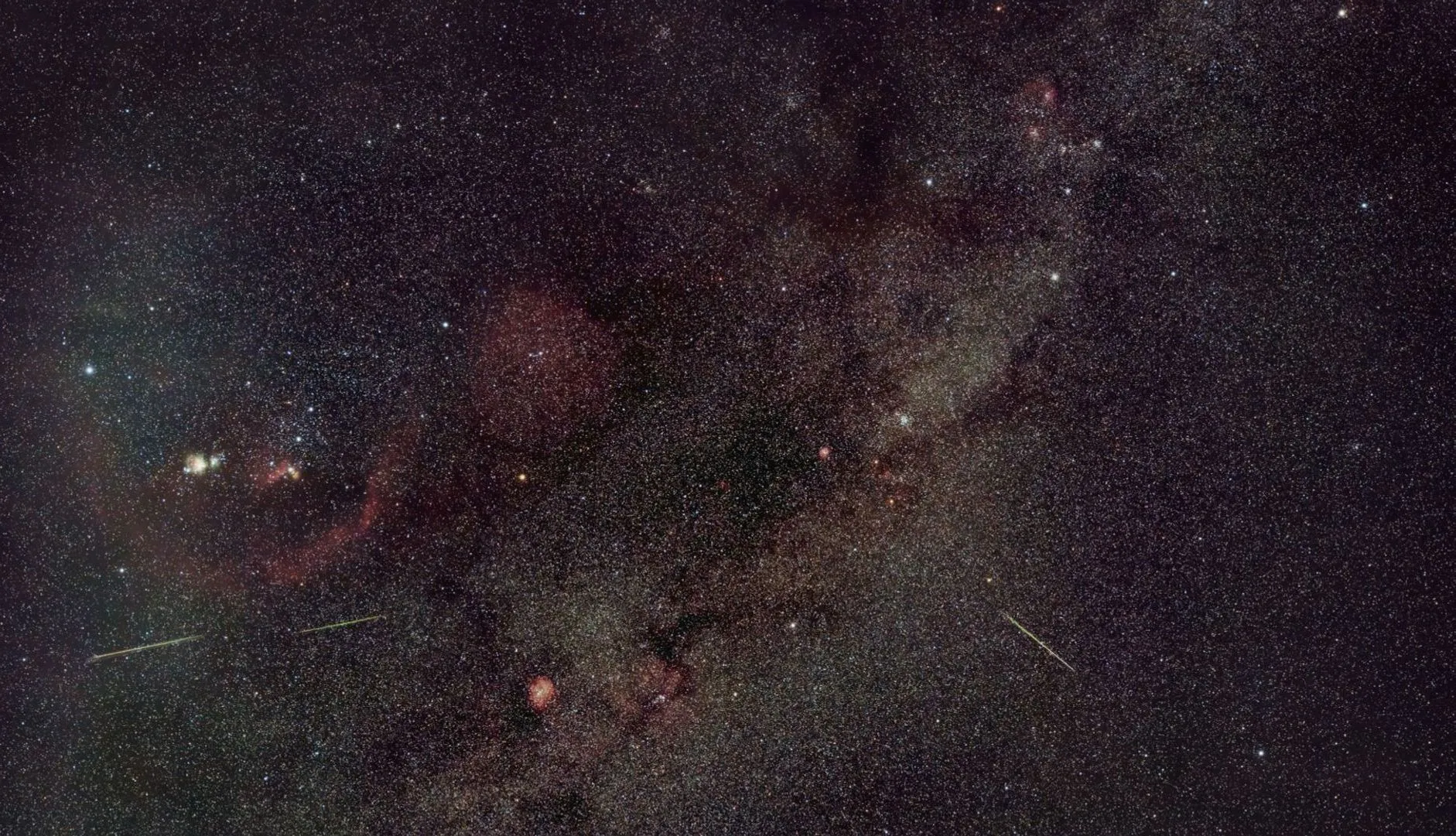
The night sky over Toccoa, Georgia, became a canvas of cosmic fire in the early hours of October 21, as astrophotographer Tim McCollum captured a rare glimpse of the Orionid meteor shower. While these streaks of light appear spontaneous, they are actually the remnants of Comet 1P/Halley. Though the famous comet itself remains billions of miles away from Earth, the debris it left behind continues to create a spectacular show every autumn as our planet plows through its trail of celestial dust.
In his striking composition, McCollum managed to freeze three vivid meteors as they raced away from their radiant point near Betelgeuse, the red giant star in the constellation Orion. Capturing such fleeting moments requires an immense amount of patience and technical precision. Using a specialized star tracker and a series of thirty second exposures with a Canon EOS Ra camera, McCollum meticulously layered several images via PixInsight software to create a single, seamless portrait of the midnight sky.
Beyond the shooting stars, the photograph offers a window into some of the deepest reaches of our galaxy. To one side, the iconic belt of Orion glistens beside the glowing clouds of the Orion Nebula, where new stars are currently being born. The image also reveals the delicate structure of the Rosette Nebula tucked within the dusty lanes of the Milky Way’s galactic plane, blending distant nebulae with high speed planetary debris in one frame.
For those hoping to catch their own glimpse of this phenomenon, there is still time to look up. The Orionids remain active until November 7, providing plenty of opportunities for stargazers to witness Halley’s legacy firsthand. Lucky observers might even spot elusive Halloween Fireballs from the Taurid meteor shower as Earth intersects another stream of debris originating from Comet Encke later in the month.