
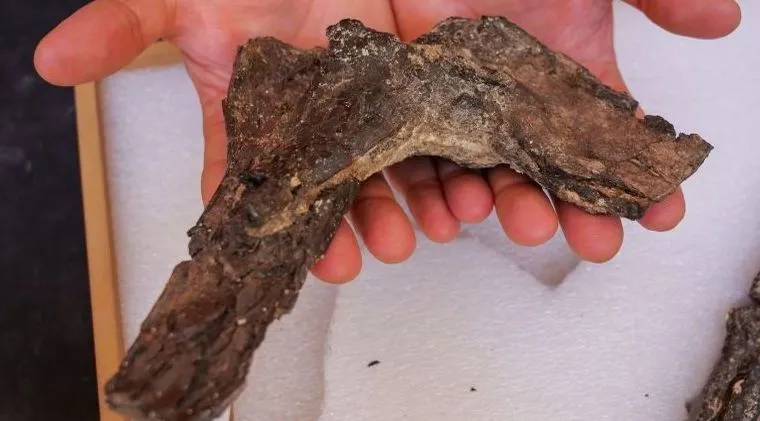
For decades, paleontologists have locked horns over whether soft biological tissues could possibly survive the brutal process of fossilization. While some claimed to see red blood cells in ancient remains, critics dismissed these findings as contamination or geological illusions. However, a new study published in the Proceedings of the National Academy of Sciences suggests that nature may have found a way to preserve these delicate structures for 115 million years. Researchers examining a hind limb of an Aratasaurus museunacionali discovered oval shaped microstructures that strongly resemble red blood cells, tucked away inside the bone’s vascular canals.
What sets this discovery apart from previous claims is the addition of chemical proof. Using advanced microscopic imaging and chemical analysis, the team identified heme, a critical component of hemoglobin that transports oxygen in living creatures. This marks the first time heme has been detected directly within such structures in a dinosaur fossil. Lead author Kliti Grice, an organic geochemist at Curtin University, explains that this combined evidence provides a far more compelling case than visual observation alone, suggesting that certain environmental conditions can freeze biological information in time.
The secret to this remarkable preservation likely lies in where the dinosaur died. Found at the Mina Pedra Branca site in Brazil, the fossil was buried in stagnant waters where low oxygen levels slowed down decay. The presence of manganese oxides may have acted as a stabilizing agent, effectively mummifying the cellular remnants within the rock. While these cells differ slightly in shape from those found in modern birds or crocodiles, researchers caution that millions of years of pressure and mineralization likely altered their original appearance.
Despite the excitement, scientists are quick to temper expectations regarding science fiction fantasies. Timothy Cleland of the Smithsonian Institution notes that finding heme does not mean we are any closer to cloning dinosaurs; DNA is a vastly different molecule with different preservation requirements than hemoglobin. Instead, the real value lies in understanding prehistoric physiology. If similar evidence can be found across other species and museum collections worldwide, it could open a window into how extinct giants breathed and functioned internally long before humans arrived on the scene.