
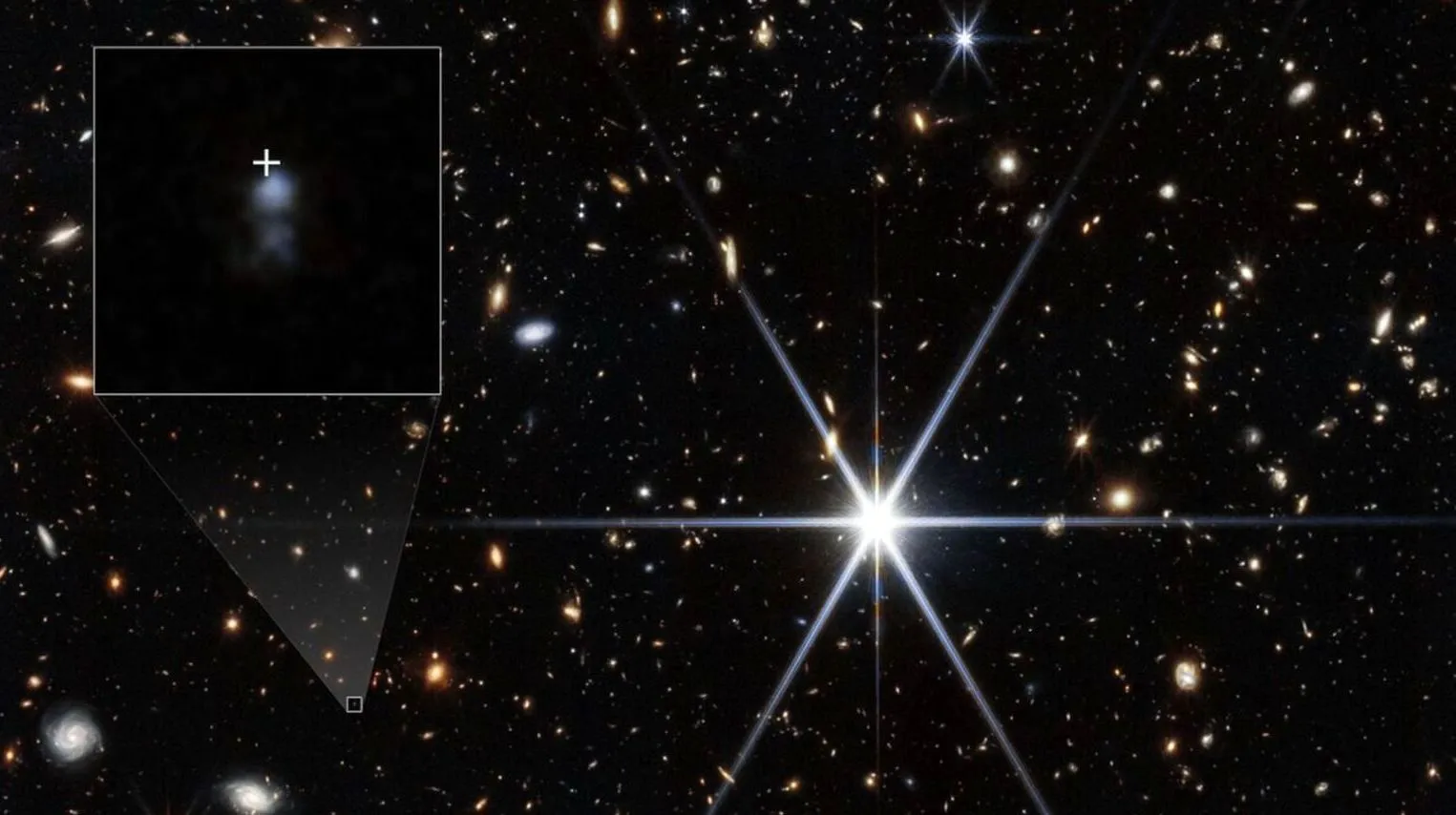
Astronomers have reached a significant milestone in understanding one of the most elusive phenomena in deep space. Using the power of the James Webb Space Telescope, researchers have successfully pinpointed the origin of the most distant fast radio burst ever recorded. These mysterious signals are incredibly brief flashes of radio waves that last only a fraction of a second yet unleash an amount of energy equivalent to what our sun produces over three full days. While these bursts have been known since 2007, their source has remained largely speculative until now.
The breakthrough began with observations from the MeerKAT ground telescope array in 2024, which flagged the signal’s existence. However, it was Webb’s advanced near infrared instruments that allowed scientists to find the specific galaxy responsible for the blast. By analyzing how the light stretched across time and space, astronomers determined that this particular event occurred roughly 3 billion years after the Big Bang. This puts the burst squarely in an era when star formation was reaching its absolute peak throughout the early universe.
What surprised researchers most was the nature of the host galaxy itself. Unlike previously detected bursts that originated in massive galaxies billions of years later, this signal came from a galaxy about 1,000 times smaller than expected. This discovery provides critical evidence regarding how these blasts are actually created. For years, theorists debated whether they were caused by two neutron stars merging or by a supernova leaving behind a magnetar, which is a neutron star with an intensely powerful magnetic field.
According to Manisha Caleb from the University of Sydney, lead author of the study published in Science, it is highly unlikely that such a young environment would allow enough time for two neutron stars to merge and collide. Instead, this finding strongly supports the theory that fast radio bursts can be triggered by cataclysmic supernovae explosions. By tracing this ancient signal back to its modest beginnings, scientists are finally beginning to piece together the lifecycle of some of the most energetic events in the cosmos.