
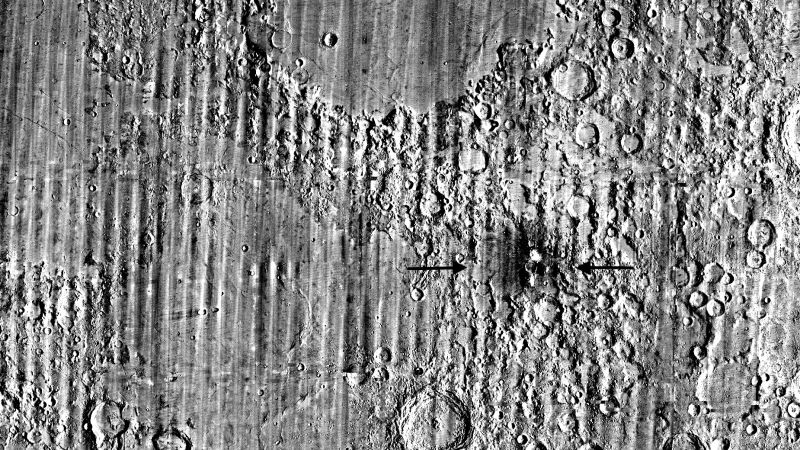
The moon has a massive new battle scar to prove that its surface remains a volatile environment. Researchers recently discovered a giant crater on the moons eastern edge, created when a space rock roughly the size of a six story building slammed into the surface sometime between April and May of 2024. Measuring 728 feet wide and 141 feet deep, the impact site is larger than two football fields and deep enough to stack three school buses on top of one another. According to a study published in Science Advances, this represents the largest newly formed crater ever detected in our solar system since humans began monitoring such events.
Scientists have named the feature McGetchin crater in honor of Dr. Thomas McGetchin, an Apollo era researcher who advanced our understanding of lunar impacts. This particular find is being described as a once in a lifetime observation because mathematical models suggest an impact of this magnitude occurs on the moon only once every 132 years. Until now, the largest contemporary crater identified was only about 230 feet in diameter, making this discovery a significant leap in scale for modern astronomy.
Finding a single new hole amidst millions of ancient ones is akin to searching for a needle in a haystack, but NASA’s Lunar Reconnaissance Orbiter proved up to the task. The spacecraft has been circling the moon since 2009, mapping everything from radiation to topography. Robert Wagner, an image processing specialist at Intuitive Machines, first spotted the anomaly on October 24, 2025, while comparing old and new maps. He describes seeing an unmistakable debris pattern that caused him to drop everything immediately to investigate further.
Beyond just adding to the map, the discovery provides vital data for future human missions under programs like Artemis. Analysis from thermal instruments showed that the impact created a four mile wide cold spot around the crater where the soil became fluffier and unable to retain heat at night. These findings serve as a stark reminder that the moon is still very much active and potentially dangerous, suggesting that any future permanent bases or infrastructure will need careful monitoring to protect astronauts from similar cosmic bombardments.