
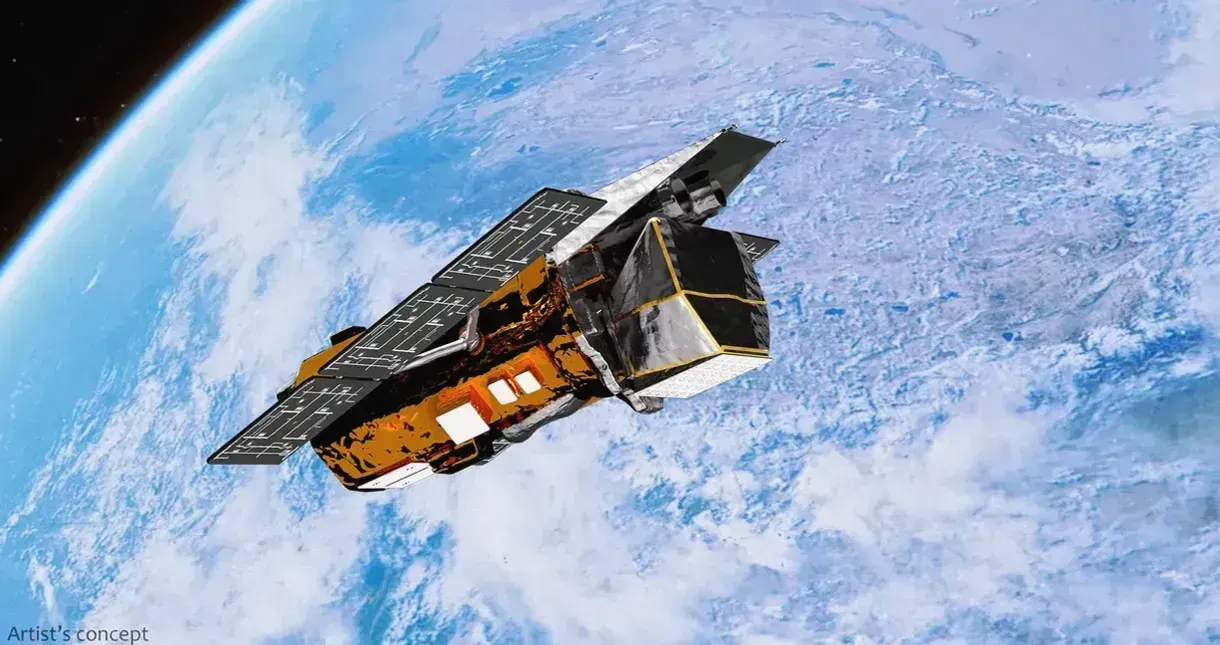
After twenty-two years of peering into the deepest reaches of the universe, the Neil Gehrels Swift Observatory is preparing for a fiery conclusion. The spacecraft, which is roughly the size of a large elevator, is expected to plunge back into Earth’s atmosphere around November 6. While its exact landing spot remains unknown, officials suggest that while portions of Africa, Asia, and the Americas are technically in the reentry zone, any surviving wreckage will likely end up in the ocean. Experts reassure the public that the risk of injury is extremely low, though some engineers argue for more transparency regarding specific impact projections.
Launched in late 2004, Swift far outlived its original design goals. Built to track gamma ray bursts and other high energy cosmic explosions, it became a cornerstone of modern astrophysics by alerting ground based observatories to fleeting celestial events in real time. Over two decades, it documented thousands of supernovas and black hole interactions, contributing to over seven thousand research papers. Its longevity ended recently when increased solar activity swelled Earth’s upper atmosphere, creating enough drag to pull the satellite lower and faster toward the surface.
A desperate attempt to save the observatory took place this past summer through a thirty million dollar rescue mission involving a robotic craft called LINK. The goal was to tow Swift higher into orbit to extend its operational life, but technical failures with the robot’s control system forced NASA to abandon the effort. By late October, Swift had dipped below one hundred seventy miles and could no longer stabilize its instruments. On October 20, after twenty years of service and ten times its expected lifespan, the observatory performed its final reading before being officially decommissioned.
As it enters the atmosphere next week, most of the spacecraft will vaporize due to intense heat. However, dense components like tungsten reaction wheels and reinforced mirror fragments may survive the trip down as small scorched pieces of debris. Though its physical form is disappearing, scientists emphasize that Swift’s legacy persists through a massive digital archive of data that researchers expect will continue fueling astrophysical discoveries for several decades to come.